
Lesson 19 The stuff of dreams 话说梦的本质
First listen and then answer the following question.
听录音,然后回答以下问题。
What is going on when a person experiences rapid eye-movements during sleep?
It is fairly clear that the sleeping period must have some function, and because there is so much of it the function would seem to be important. Speculations about its nature have been going on for literally thousands of years, and one odd finding that makes the problem puzzling is that it looks very much as if sleeping is not simply a matter of giving the body a rest. 'Rest', in terms of muscle relaxation and so on, can 5 be achieved by a brief period lying, or even sitting down. The body's tissues are self-repairing and self-restoring to a degree, and function best when more or less continuously active. In fact a basic amount of movement occurs during sleep which is specifically concerned with preventing muscle inactivity.
If it is not a question of resting the body, then perhaps it is the brain that needs resting? This might be a plausible hypothesis were it not for two factors. First the electroencephalograph (which is simply a device 10 for recording the electrical activity of the brain by attaching electrodes to the scalp) shows that while there is a change in the pattern of activity during sleep, there is no evidence that the total amount of activity is any less. The second factor is more interesting and more fundamental. Some years ago an American psychiatrist named William Dement published experiments dealing with the recording of eye-movements during sleep. He showed that the average individual's sleep cycle is punctuated with peculiar bursts of eye-movements, 15 some drifting and slow, others jerky and rapid. People woken during these periods of eye-movements generally reported that they had been dreaming. When woken at other times they reported no dreams. If one group of people were disturbed from their eye-movement sleep for several nights on end, and another group were disturbed for an equal period of time but when they were not exhibiting eye-movements, the first group began to show some personality disorders while the others seemed more or less unaffected. The ) implications of all this were that it was not the disturbance of sleep that mattered, but the disturbance of dreaming.
Christopher Evans The stuff of dreams from The Listener
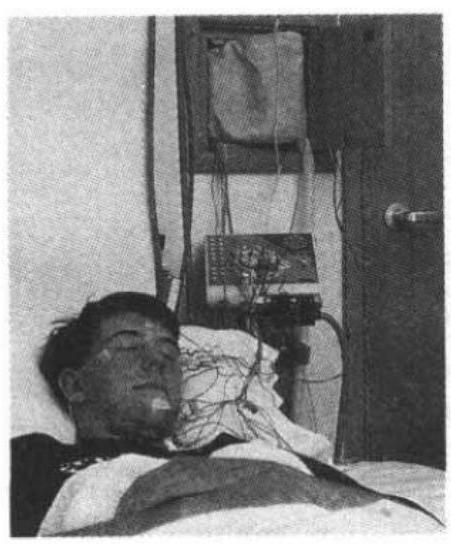
Circadian rhythm experiment. A patient is asleep in a sleep research laboratory. Electrodes are attached to his head to measure brainwaves.
Unit 3 Lesson 19
New words and expressions 生词和短语
speculation (1.2) $/$ spekjʊ’leɪʃən $/n$ . 推测 electrode (1.10) $/{I}^{\prime }$ lektrəʊd $/n$ . 电极
literally (1.2) /'lɪtərəli/adv. 确实 scalp (1.10) /skælp/ n. 头皮
odd (1.3) /pd/ adj. 奇特的 psychiatrist (1.12) /saɪ'kaɪətrɪst/ n. 精神病学家
tissue (1.5) /*trsju:/ n. 组织 punctuate (1.14) /’ $p$ ʌŋktfueɪt/ $v$ . 不时介入
plausible (1.9) /'plɔ:zәbәl/adj. 似乎有理的 jerky (1.15)/dʒ3:ki/ adj. 急动的
hypothesis (1.9) / haɪ'pɒθɪsɪs/ n. 假说 disorder (1.19) $/$ dIs $\sigma \neq 0$ :d $\theta /n$ . 失调
electroencephalograph (1.9) /ɪˌlektrəʊɪnˈsefələɡrɑːf/ implication (1.19) ${/}_{1}{\mathrm}^{1}\mathrm\int a\mathrm{n}/n$ . 表明 n. 脑电图仪
Notes on the text 课文注释
✓
1 in terms of muscle relaxation and so on, 从使肌肉得到放松等方面来看。in terms of, 从 …… 方面看。
2 then perhaps it is the brain that needs resting? 这是个陈述句的语序, 但句尾加问号, 表示说话人对这种观点有把握但需进一步证实。
3 were it not far two factors, 这是省略了 if 的条件句, 可译作 “如果不是下面两个因素的话”。
4 several nights on end, 一连几夜。
参考译文
很清楚, 睡眠必然具有某种作用。睡眠占去那么多时间, 所以其作用似乎还很重要。人们对睡眠作用的种种猜测,确实已有数千年之久。一项使人对这个问题感到困惑的奇怪的发现是,睡眠在很大程度似乎并不仅仅是为了使身体得到休息。“休息”,从使肌肉得到放松等方面来看,只要稍微躺一躺,甚至坐一坐就能达到。人体组织在一定程度上有自我修补和自我恢复的能力, 有张有弛地连续活动时, 其功能最佳。事实上, 睡眠状态下仍有着基本的活动量, 以防止肌肉活动停止。
如果睡眠的功能不是在于使身体得到休息,那么也许是让大脑得以休息?若不是下面两点,这种假设似乎是有道理的。第一点, 脑电图记录仪 (不过是一种把电极接到头皮上记录脑电活动的仪器) 显示, 人在睡眠时大脑活动的方式有变化, 但没有迹象表明, 其活动总量有任何减少。第二点更有意思, 也更重要。前些年, 美国一位精神病学者发表了一篇报告,报告中记录了眼球在睡眠时的活动情况。他指出,平常人的睡眠周期中不时伴有一阵阵奇怪的眼球活动, 这些活动有的飘忽而缓慢, 有的急剧而快速。在眼球活动期间被叫醒的人都说自己在做梦; 在其他期间叫醒他们, 则说没做梦。如果有两组人, 一组人连续几夜在眼球活动时被叫醒; 另一组人也是连续几夜被叫醒, 但是在眼球没活动时被叫醒的。结果, 第一组人开始出现性格失常, 而第二组人似乎没受什么影响。这一切暗示我们: 睡眠受到干扰没关系, 而做梦受到干扰是有问题的。
Comprehension 理解
Answer these questions:
1 How does the author disprove the idea that we sleep in order to rest our muscles?
2 What is the relationship between eye-movements during sleep and dreaming?
Vocabulary 词汇
Refer to the text to see how the following words have been used, then write sentences of your own using these words: function (1.1); speculations (1.2); specifically (1.7); plausible hypothesis (1.9); evidence (1.11); fundamental (1.12); punctuated (1.14); jerky and rapid (1.15); implications (1.19).
Unit 3 Lesson 19
The paragraph 段落
1 Drawing your information from the second paragraph (lines 8-20), write a list of points in note form to answer the following question: What appears to be the main function of the sleeping period?
2 Read the first paragraph again (lines 1-7). Then, using the list of points given below, reconstruct the paragraph in your own words as far as possible. Do not refer to the passage until you have finished the exercise:
$a$ We sleep a great deal: sleep must have a function.
$b$ Problem has puzzled mankind thousands of years.
c Purpose of sleep is not to give the body a rest.
$d$ We do not have to sleep to relax the muscles: this can be done by lying or sitting down for short periods.
$e$ Body tissues function best when muscles are active.
$f$ Movement occurs during sleep to prevent muscle inactivity.
3 Write a paragraph of about 200 words on one of the following subjects:
Briefly describe a dream you had and attempt to interpret it.
Sleep.
Key structures 关键句型
A Supply the missing words in the following sentences. Do not refer to the passage until you have finished the exercise:
1 Speculations _____ its nature have been going on _____ literally thousands _____ years _____. (II. 2-3)
2 In fact a basic amount _____ movement occurs _____ sleep which is specifically concerned _____ preventing muscle inactivity. (11.6-7)
3 Some years ago an American psychiatrist named William Dement published experiments dealing _____ the recording _____ eye-movements _____ sleep. (ll.12-13)
4 If one group _____ people were disturbed _____ their eye-movement sleep _____ several nights _____ end, and another group were disturbed _____ an equal period _____ time. (ll.16-18)
B Note the use of for in this sentence:
Speculations about its nature have been going on for literally thousands of years. (II.2-3)
Supply for or since in the following sentences:
1 He has been going to work regularly _____ he recovered from his illness.
2 They have been working overtime _____ several months.
3 The election results have been coming in steadily _____ midnight.
4 She's been working on her novel _____ the beginning of the year.
C Study this sentence:
Perhaps it is the brain that needs resting? (1.8)
Write similar sentences using the verbs want or need with the following words: cleaning; mending;
decorating.
Unit 3 Lesson 19
D Compare these two sentences:
Instead of saying: This might be a plausible hypothesis were it not for two factors. (II.8-9)
We can say: This might be a plausible hypothesis if it were not for two factors.
Rewrite the following sentences using if:
1 Were it possible, I would leave tomorrow.
2 I would take action at once were it not too late.
3 Were this allegation true, he would be arrested.
Special difficulties 难点
A Study the following pairs of words and then write sentences of your own to bring out the difference.
1 fairly (1.1) - enough
The water is fairly warm.
The water is warm enough to swim in.
2 puzzling (1.3) - confusing
The children showed a puzzling lack of curiosity about where their parents were.
The instructions are so confusing that I can't work out what they're saying.
3 factor (1.12) - fact
The rise in crime is mainly due to social and economic factors.
It is a fact that most deaths from lung cancer are caused by smoking.
B Explain the meaning of the verbs in italics in these sentences:
1 William Dement published experiments dealing with the recording of eye-movements. (I.13)
2 We have been dealing with the same firm for a number of years.
3 He's an extremely difficult child. His father is the only person who knows how to deal with him.
C Explain the meaning of the phrases in italics in these sentences:
1 If one group of people were disturbed from their eye-movement sleep for several nights on end ... (II.16-17)
2 It wasn't an accident. That window was broken on purpose.
3 On the whole, business has been very good this year.
4 The doctor's very tired. He's been on duty for fourteen hours.
5 How many soldiers are on leave?
6 You mustn't open the door on any account when I'm out.
7 It's getting late. I must be on my way.
Multiple choice questions 多项选择题
Choose the correct answers to the following questions.
Comprehension 理解
1 Giving the body a rest _____.
(a) seems to be the main function of sleep
(b) doesn't seem to be the main function of sleep
(c) means that sleep must have some function
(d) prevents muscle inactivity Unit 3 Lesson 19 2 Electrical activity _____.
(a) is a good indication of the way the body rests during sleep
(b) doesn't seem to diminish during sleep
(c) is a plausible explanation for the function of sleep
(d) must always be recorded during sleep
3 Rapid eye movements are an indication that _____.
(a) a person is having a disturbed sleep
(b) sleep is very deep
(c) that a sleeper is dreaming
(d) that a person is drifting into sleep
4 One of these statements is true. Which one?
(a) The most important function of sleep is dreaming.
(b) Rapid eye-movement is associated with deep sleep.
(c) People who experience rapid eye-movements show personality disorders.
(d) When people are woken, they don't report any dreams.
Structure 句型
5 _____ have speculations gone on? - For thousands of years. (II.2-3)
(a) How many (b) How often (c) How much (d) How long
6 The bodies tissues can repair _____ .
(a) themselves (b) their self (c) itself (d) them
7 Peculiar bursts of eye-movements _____ an individual's sleep. (1.14)
(a) punctuate (b) is punctuating (c) are punctuating (d) have punctuated
8 People woken during these periods of eye-movements generally reported that they had been dreaming _____. (ll.15-16)
(a) for a while (b) during sleep
(c) before they went to sleep (d) just this moment
Vocabulary 词汇
9 Speculations have been going on for thousands of years _____ . (II.2-3)
(a) so to speak (b) in history (c) and recorded (d) in fact
10 This might be a plausible _____ . (11.8-9)
(a) conclusion (b) deduction (c) philosophy (d) theory
11 The second factor is more interesting and more _____ . (1.13)
(a) obvious (b) basic (c) apparent (d) acceptable
12 Some eye-movements were slow, others _____ and rapid. (1.15)
(a) smooth, quick (b) interrupted
(c) sudden, irregular (d) painful, repeated