
Lesson 5 Youth 青年
First listen and then answer the following question:
听录音,然后回答以下问题。
How does the writer like to treat young people?
People are always talking about 'the problem of youth'. If there is one-which I take leave to doubt-then it is older people who create it, not the young themselves. Let us get down to fundamentals and agree that the young are after all human beings-people just like their elders. There is only one difference between an old man and a young one: the young man has a glorious future before him and the old one has a splendid future 5 behind him: and maybe that is where the rub is.
When I was a teenager, I felt that I was just young and uncertain - that I was a new boy in a huge school, and I would have been very pleased to be regarded as something so interesting as a problem. For one thing, being a problem gives you a certain identity, and that is one of the things the young are busily engaged in seeking.
I find young people exciting. They have an air of freedom, and they have not a dreary commitment to mean ambitions or love of comfort. They are not anxious social climbers, and they have no devotion to material things. All this seems to me to link them with life, and the origins of things. It's as if they were, in some sense, cosmic beings in violent and lovely contrast with us suburban creatures. All that is in my mind when I meet a young person. He may be conceited, ill-mannered, presumptuous or fatuous, but I do not turn 15 for protection to dreary clichés about respect for elders-as if mere age were a reason for respect. I accept that we are equals, and I will argue with him, as an equal, if I think he is wrong.
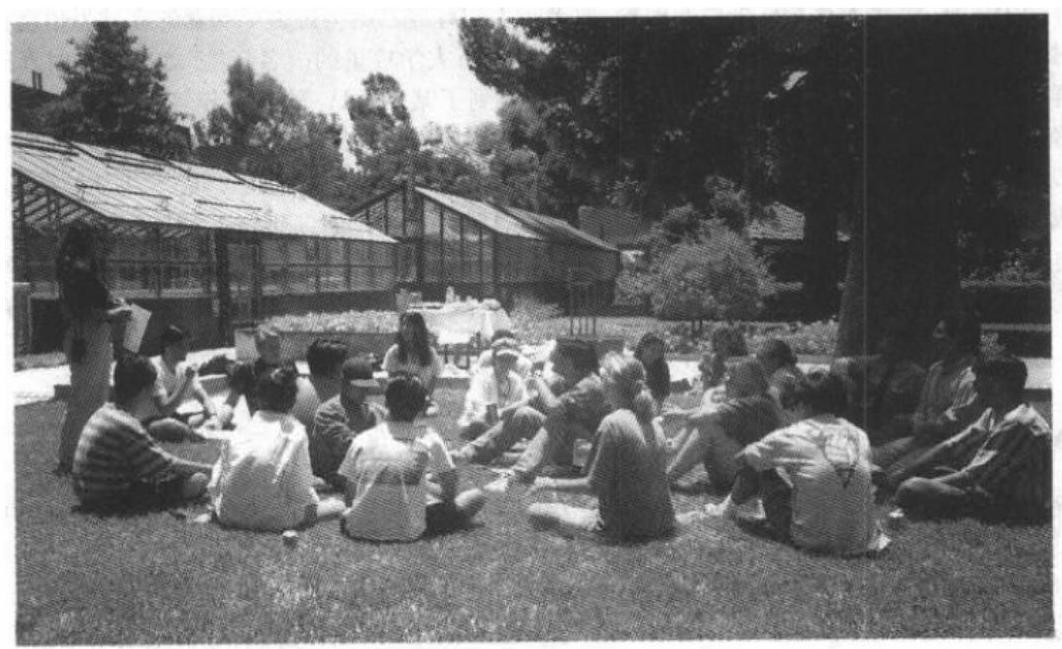
A group of young people
Unit 1 Lesson 5
New words and expressions 生词和短语
leave (1.1) /li:v/ n. 允许
fundamentals (1.2) /,fʌndə'mentlz/ n. 基本原则
glorious (1.4) /'glɔ:riəs/ adj. 光辉灿烂的
splendid (1.4) /'splendid/ adj. 灿烂的
rub (1.5) /rʌb/ n. 难题
identity (1.8) /aɪ'dentɪti/ n. 身份
dreary (1.10) /'drɪəri/ adj. 沉郁的
commitment (1.10) /kə'mɪtmənt/ n. 信奉
mean (1.11) /mi:n/ adj. 吝啬, 小气
social climber (1.11) /ˌsəʊʃəlˈklaɪmə/ 追求更高社会地位的人,向上爬的人
devotion (1.11) /dɪˈvəʊʃən/ n. 热爱
cosmic (1.13) /ˈkɒzmɪk/ adj. 宇宙的
suburban (1.13) /səˈbɜːbən/ adj. 见识不广的,偏狭的
conceited (1.14) /kənˈsiːtɪd/ adj. 自高自大的
presumptuous (1.14) /prɪˈzʌmptʃuəs/ adj. 自以为是的,放肆的
fatuous (1.14) /ˈfætʃuəs/ adj. 愚蠢的
cliché (1.15) /ˈkliːʃeɪ/ n. 陈词滥调
Notes on the text 课文注释
1 which I take leave to doubt, 这是一个插入成分, 用两个破折号与句子的主要部分分开。take leave to do sth. 是“擅自做”,“冒昧去做”的意思。
2 get down to, 认真处理, 认真研究。
... that is where the rub is. There's the rub. = That's the problem. 这就是问题所在。
4 for one thing, 首先。
5 air of freedom, 无拘无束。
6 in some sense, 在某种意义上。
7 turn to ... for ...,为 …… 而求助于 ……。
参考译文
人们总是在谈论“青年问题”。如果这个问题存在的话——请允许我对此持怀疑态度——那么,这个问题是由老年人而不是青年人造成的。让我们来认真研究一些基本事实:承认青年人和他们的长辈一样也是人。老年人和青年人只有一个区别:青年人有光辉灿烂的前景,而老年人的辉煌已成为过去。问题的症结恐怕就在这里。
我十几岁时, 总感到自己年轻, 有些事情拿不准一一我是一所大学校里的一名新生, 如果我当时真的被看成像一个问题那样有趣,我会感到很得意的。因为这至少使我得到了某种承认,这正是年轻人所热衷追求的。
我觉得年轻人令人振奋,无拘无束。他们既不追逐卑鄙的名利,也不贪图生活的舒适。他们不热衷于向上爬,也不一味追求物质享受。在我看来,所有这些使他们与生命和万物之源联系在了一起。从某种意义上讲,他们似乎是宇宙人,同我们这些凡夫俗子形成了强烈而鲜明的对照。每逢我遇到年轻人,脑子里就想到这些。年轻人也许狂妄自负,举止无理,傲慢放肆,愚昧无知,但我不会用应当尊重长者这一套陈词滥调来为我自己辩护, 似乎年长就是受人尊敬的理由。我认为我和他们是平等的。如果我认为他们错了, 我就以平等的身份和他们争个明白。
Comprehension 理解
Give short answers to these questions in your own words as far as possible. Use one complete sentence for each answer.
1 What, according to the writer, is the one difference between an old man and a young one?
2 Why would the writer have been pleased to have been regarded as a problem when he was young?
3 Name three qualities in young people which the author particularly admires.
Unit 1 Lesson 5
Vocabulary 词汇
Refer to the text to see how the following words have been used, then write sentences of your own using these words: create (1.2); teenager (1.6); devotion (1.11); link (1.12); origins (1.12); dreary (1.15).
Sentence structure 句子结构
A Complete the following sentences in any way you wish. Then compare what you have written with the sentences in the passage:
There is only one difference between an old man and a young one: _____ . (11.3-4)
2 When I was a teenager, I _____ . (1.6)
3 I find young people exciting. They _____ . (1.10)
B Combine the following statements to make complete sentences. Add conjunctions of your own and omit the words in italics. Do not refer to the passage until you have finished the exercise.
1 If there is one, I take leave to doubt it. It is older people who create it. It is not the young themselves. (II.1-2)
2 They are not anxious social climbers. They have no devotion to material things. (II.11-12)
C Write three statements which an adult might make to criticize adolescents.
D Write three statements which an adolescent might make to criticize adults.
Key structures 关键句型
A Compare these two sentences:
People are always talking about 'the problem of youth'. (1.1)
Whenever I meet him, he always talks about his personal problems.
The first sentence describes something that happens all the time; the second sentence describes some-
thing that happens frequently.
Write similar pairs of sentences using the following verbs: change; make; tell; ask.
B Compare these two sentences:
It is older people who create it, not the young themselves. (I.2)
There is only one difference between an old man and a young one. (II.3-4)
Write similar pairs of sentences using the following words: the rich, a rich man; the sick, a sick man; the
blind, a blind man; the dead, a dead man.
C Compare these two sentences:
Instead of saying: I would have been very pleased if anyone regarded me as a problem.
We can say: I would have been very pleased to be regarded as a problem. (1.7)
Write these sentences again using this construction with to be in place of the phrases in italics:
1 You would not like it if you were accused of theft.
2 I was astonished when they told me that all the tickets had been sold out.
3 I expect they will inform me about it tomorrow. Unit 1 Lesson 5 D Compare these two sentences:
Instead of saying: To be a problem gives you a certain identity.
We can say: Being a problem gives you a certain identity... (1.8)
Rewrite these sentences changing the form of the verbs in italics:
1 It is not very pleasant to have to write so many letters.
2 To expect others to help you and then not to help them in return is hardly commendable.
3 It is very enjoyable to teach young children.
E Note the construction in italics:
That is one of the things the young are busily engaged in seeking. (II.8-9)
Write sentences using the same construction with the following verbs: delight; interest; persist; believe.
F Compare these two sentences:
Instead of saying: They have no devotion to material things. (II.11-12)
We can say: They haven't any devotion to material things.
Write these sentences again using not ... any in place of no.
1 He doesn't know. There's no point in asking him.
2 You'll pass your driving test if you make no mistakes.
3 I have no faith in him.
Special difficulties 难点
A Study the following pairs of words and then write sentences of your own to bring out the difference.
1 older (1.2) - elder
I know both buildings are very old, but which one is older?
My elder brother is a doctor.
2 agree (1.2) - accept
They invited me to their wedding and I've agreed to go. (agree to do something)
She offered me some clothes her children had grown out of and I accepted them. (accept + object = take what is
offered)
But agree and accept are interchangeable in the text, as in these sentences:
I don't agree with your opinion/accept your opinion of the youth of this country. I agree/I accept that this is a
difficult matter.
3 between (1.3) - among
It's hard to choose between these two pictures. I like them both.
There are quite a few talented artists among the people I know.
4 please (I.7) - begged
It pleases me to say you've got the job.
I begged the traffic-cop not to book me for speeding and he just laughed.
5 regard (1.7) - look at
I don't regard a degree as a meal ticket for life.
Just look at those children picking apples.
6 interesting (l.7) - interested
I found his talk very interesting.
I got interested in stamp collecting when I was a child.
Unit 1 Lesson 5
7 exciting (I.10) - excited
There are some exciting items in the current fashion show.
We got excited when we thought we had won the lottery.
8 reason (1.15) - cause
What was the reason for the delay?
The doctor recorded the cause of death as heart failure.
B Note this phrase with get:
Let us get down to fundamentals. (1.2)
Explain these expressions with get:
1 The children are very quiet. I wonder what they're getting up to.
2 I can't see how we can get round this difficulty.
3 I've been abroad three times this year. I get about quite a bit.
4 Hasn't she got over her illness yet?
5 Don't think you'll get off so lightly if you're caught.
6 It's your turn to do the washing up and it's no use your trying to get out of it.
C Note the phrase in italics:
He may be ill-mannered. (1.14)
Write sentences using the following adjectives:
ill-advised; ill-protected; ill-tempered; ill-fated; ill-used; ill-bred; ill-natured.
Multiple choice questions 多项选择题
Choose the correct answers to the following questions.
Comprehension 理解
1 What's the main difference between young people and old people?
(a) Old people think of the young as 'a problem'.
(b) Old people create this 'problem' of age difference.
(c) Old people have a past; young people have a future.
(d) Old people and young people forget they are all human beings.
2 One of the things young people want to do is to _____
(a) find out who they are
(b) make sure they become 'a problem'
(c) feel uncertain about themselves
(d) feel they are in a huge school
3 According to the writer, young people .
(a) are conceited, ill-mannered or fatuous
(b) don't see life in the same way their elders do
(c) don’t have any ambitions
(d) come from another planet Unit 1 Lesson 5
4 The writer doesn't believe that _____ .
(a) people automatically deserve respect because they are old
(b) young people and old people are equals
(c) you should argue with young people if they are wrong
(d) young people have any faults
Structure 句型
5 The problem, if there is one, _____ by older people. (1.2)
(a) created (b) is created (c) creates (d) is creating
6 For one thing, if you _____ a problem, you have a certain identity. (ll. 7-8)
(a) were (b) being (c) had (d) are
7 _____ to be linked with life, and the origin of things. (1.12)
(a) They seem (b) It seems (c) This seems (d) What seems
8 It is _____ they are conceited and ill-mannered. (1.14)
(a) necessary (b) permissible (c) possible (d) likely
Vocabulary 词汇
9 Let us get down to _____ . (1.2)
(a) what is needed (b) basics (c) the end (d) the bottom
10 Perhaps that's where the _____ is. (1.5)
(a) wound (b) problem (c) hurt (d) injury
11 Identity is one of the things in life the young are busy
(a) looking at (b) looking to (c) looking over (d) looking for
12 That's what I _____ when I meet a young person. (ll.13-14)
(a) am annoyed with (b) care about
(c) object to (d) think about